Transition Internal Support to 3rd Party Vendor
Outsourcing Field Services to a Third Party Vendor — platinum-level white glove service for all employees.
Client / Company
Macy's
Project Date
Feb 2019 – August 2019
My Role
Senior Support / Macintosh Software Management, and Assistant Manager. I was transitioned to the 3rd party vendor as a Senior Support Specialist with similar responsibilities.
Project Summary
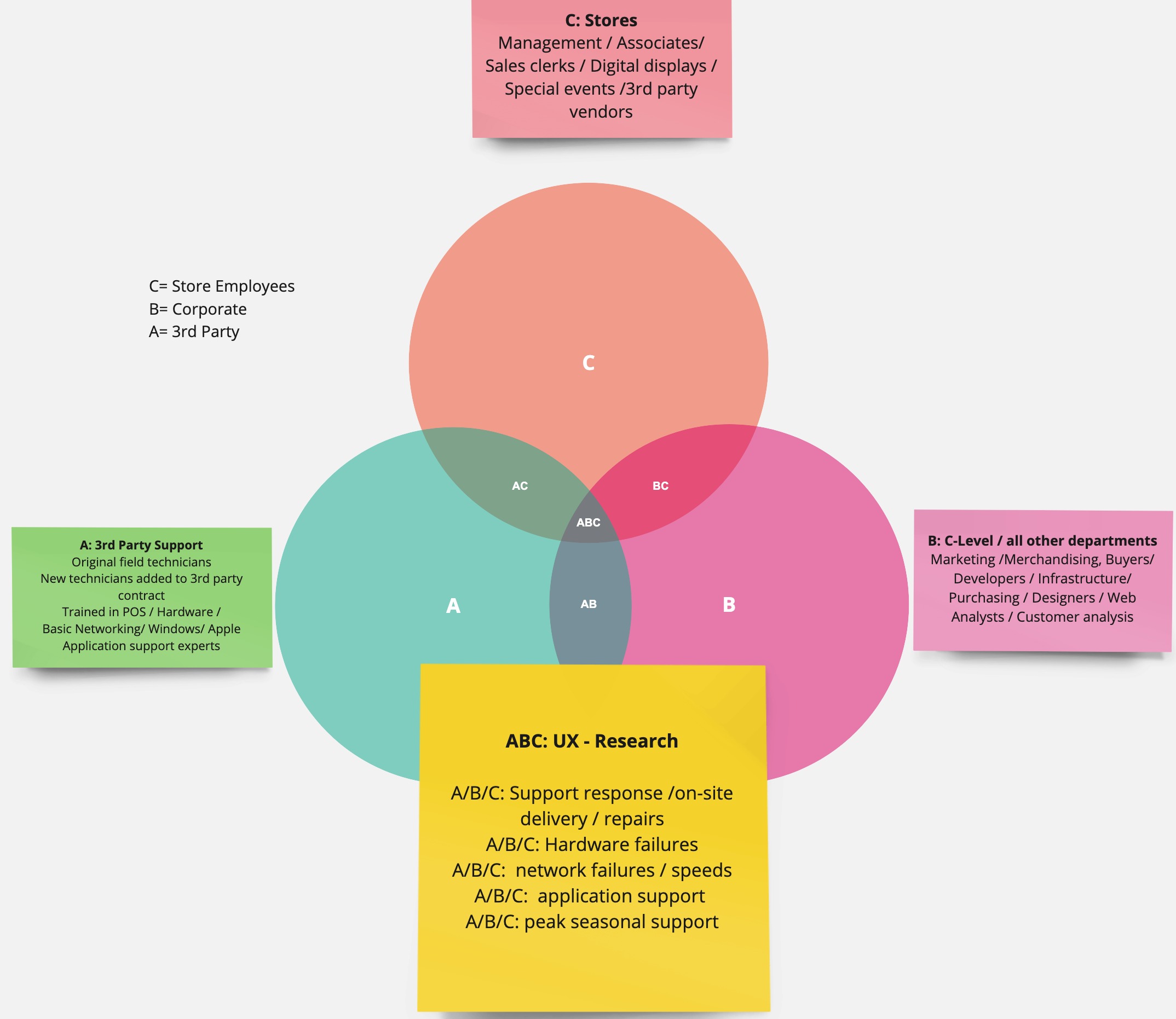
The project was to transition seamlessly all remaining field service support roles to an external 3rd party vendor by region. Herald Square and Bloomingdale's in NYC were the last locations to go, as they housed both store and non-store employees.
Store Support transitioned with little impact to the users, as they were getting registers, printers, and WiFi issues resolved with dedicated on-site support and faster responses from available technicians. Office Support / Executives were handled differently, as they required more hands-on, on-site technicians and faster response times. This group involved multiple dedicated locations requiring onsite dedicated technicians. Solutions included a more consistent way of creating tickets and requesting support, a clear boundary of what was and wasn't supported, and faster part replacements and repair availability.
The Challenge
Providing white glove executive support with a new vendor with different organizational philosophies, while trying to establish best practices in a new support model. End users required and expected the same level of support and responsiveness no matter what.
Challenge 1: Establishing an inventory of replaceable parts — keyboards, mice, laptop batteries, desk phones, docking stations, power cords, laptops, and monitors.
Challenge 2: Apple products — OS compatibility with internal systems (not ready for the current or latest operating system, and Mac hardware not able to be rolled back to an older OS), along with compatible Apple power supplies, keyboards, mice, cables, and monitors.
Challenge 3: Transitioning from being able to open tickets on our own to waiting for internal tickets to transfer to the 3rd party vendor system in order to help end users. This included errors with wrong device types, wrong contact information, wrong building information, and sync issues between the two systems. Technicians struggled learning how to work off Android phones with the 3rd party custom ticket system while responding to end users quickly and efficiently, and addressing their complaints and concerns.
Solution
Solution 1: Completed training and assisted coworkers as they were learning the new workflows.
Solution 2: Taught end users how to create tickets properly and walked them through how the new support system worked. We also provided quick and responsive support, often resolving issues before the tickets had made it through the automated system.
Solution 3: Replacement parts were vastly improved once the new storage system and ordering process was established. It took 1–2 days to receive parts and replace broken devices.
Solution 4: Apple hardware repairs are difficult and take longer, but improved with AppleCare alternatives, while replacement laptops could be ordered or purchased faster.
Lessons learned: use the AppleCare warranty, and find alternatives to use in place of Apple-branded accessories to save money and replace broken mice, keyboards, and dongles.
Ticket system training needs to be completed on your own device so you can truly get a feel for how to work through a ticket, along with access to the desktop version of the same system. We used company phones to respond to teams and emails and complete the hardware repair process.
Results
Support transitioned and stores saw a much faster turnaround with their needs and improved support.
Executive Support changed to meet a 4-hour SLA agreement, and the overall contract has been rewritten five different times. Each version of the contract involved support changes for custom internal applications, printers, conference rooms, C-suite support, and special events.